
Leigha Lynch (Chair) chair.dpcb@sicb.org, Molly Womack (Program Officers) dpo.dbcb@sicb.org; Jennifer Hodge (Secretary), secretary.dpcb@sicb.org; Zehua (Tony) Zhou (SPDAC representative) tonyzhou.150522@gmail.com
Statement from Outgoing DPCB Chair
Samantha Price, Chair, chair.dpcb@sicb.org
It was great to see so many DPCB members at the annual meeting in Atlanta. Our division had a packed schedule, with the ever popular “Ask an Expert” booth during the poster sessions, fantastic presentations by our finalists for the Wake Award for Best Student Presentations and the Chair’s Special Session. Our special session this year celebrated “What mammals have taught us through organism-focused evolution” with fascinating talks from Anderson Feijo, Anjali Goswami, Christine Lee, Stephanie Smith, Hartrich Zack as well as our incoming DPCB Chair Leigha Lynch. Although I now spend most of time working with fishes, mammals were my first love, so I had a fabulous time learning about the function of the ‘thumb nail’ in rodents, the impact of altriciality on rates of cranial evolution, the relationship between tails and axial skeleton stiffening, the mechanical properties of small mammalian vertebrae, a new multivariate categorization scheme for locomotor ecology and intraspecific variation in the inner ear of river otters.Thank you to all our speakers and everyone who came to the talks.
I have greatly enjoyed serving as your DPCB Chair for the past few years. I have been inspired by our incredible early career researchers competing in the Wake Award and encouraged by our increasing membership and divisional engagement. Thank you for your support of DPCB. We have a great divisional and SICB leadership team to guide us through whatever the future may hold.
Updates on DPCB Leadership
As we wave goodbye to Sam as our chair, we are happy to welcome some new members to the DPCB leadership. Leigha Lynch is now our Divisional Chair and Jen Hodge is starting her term as secretary elect.
Ask-an-expert Booth
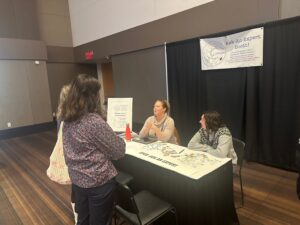
The Ask-an-expert booth returned this year to great success! A few dozen people visited to get coding and methods advice from our esteemed experts. We covered a huge range of topics this year, from bioimaging to systematics to morphometrics. We will be running the expert booth again in 2026 in Portland. If you’d like to get involved as an expert, reach out to divisional secretary Ryan Felice.
Best Student Presentation Award Winners
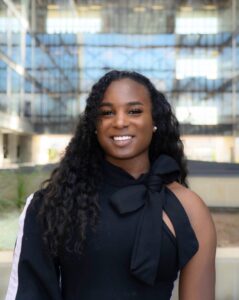
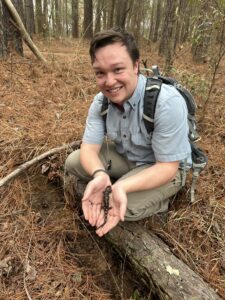
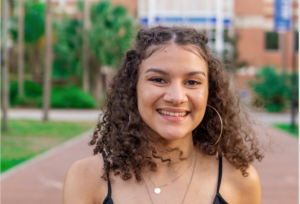
David and Marvalee Wake Best Student Presentation session was a great line-up of fascinating talks and posters. This year the award for best talk went to Jess Sterling for “Mitochondrial resilience: Unveiling the secrets of longevity”. Nathalie Alomar was awarded an honorable mention for her talk, “Hidden dimensions of diversity in woodland salamanders”. In the best poster category, Dartagnan Mullins was our winner with his presentation “Modularity and rate of phenotypic evolution among Appalachian salamanders (Plethodontidae)”. To learn more about student award winners, please read here.
Election Update
It is time to vote for DPCB’s next program officer-elect. The elected person will serve as program officer elect for one year, training under our current program officer (PO), Molly Womack, before taking over as our PO for a two year term. The PO plays a key role in setting the program for the annual meetings and scheduling our best student presentation sessions. Here are our candidates and their profiles. We hope that you will take the opportunity to vote in the election and guide the future of the division. Please vote here.
Program Officer Candidates
Name: Thornton (Thor) R. Larson

Current Position: Assistant Professor and Curator of James F. Scudday Vertebrate Collection, Sul Ross State University, Alpine, TX
Education: Ph.D., University of Texas at Arlington, 2021; M.S., University of Texas at El Paso, 2015; B.S., Northland College, 2011
Research Interests: Much of the research in my lab looks at how biogeographic mechanisms reflect biodiversity and species distributions. I focus on amphibians and reptiles of Indonesia because the diversity there is absolutely amazing and understated. Indonesia is filled with some of the most fantastic people. We currently utilize phylogenetic and morphometric methods to compare populations of species. The locality of Sul Ross has led to further studies within the Big Bend region of Texas. These studies are more concerned with the color phenotypes of desert reptiles and how they operate within their environments. I am curious about how the environment maintains multiple phenotypes within a small area.
SICB Activities: I first got involved with SICB as a graduate student, receiving a Charlotte Magnum and GIAR. I was charmed by how warm and welcoming the meeting was, and I have gotten more involved since. I have gotten myself involved with the membership committee as of January 2024, which is becoming more active after a period of being less so. I also participate in the PUI group at SICB, which has been wonderful to be a part of. For the DPCB activity, I judged the Wake Award and always try to offer myself up for any tasks that I can be useful. I enjoy contributing through small and simple contributions such as an award judge or more significant commitments to my organizations.
Goals Statement: My primary goal as a DPCB Program Officer would be to continue the rising profile of the division, especially as it seems our division numbers have seen a rise from our initiatives, such as the Wake Awards and Ask-an-Expert booth. In this role, I would like to enhance and expand our connections to drive a strong sense of belonging to those who come to SICB, whether it is for the first time or for someone more seasoned. Meetings have been a place for me to share research, learn about what’s being researched, and, most importantly, where I continue to find my people (creating connections). I would like to broaden participation to encourage more connections at all levels (student, postdoc, PI, etc.) within the society and believe that acting in the role of Program Officer could build toward that.
Name: Jason Pienaar
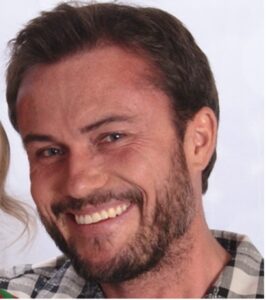
Current Position: Assistant Professor, Florida International University
Education:Ph.D. (2005) University of Pretoria, South Africa; BSc. (2000) University of Pretoria, South Africa
SICB Activities: I am very new to SICB, having attended the 2025 meeting in Atlanta, but was blown away by the diversity of topics, quality of presentations and the excellent mix of student and faculty presentations. I manned the “Ask an Expert” booth on phylogenetic and comparative biology, chaired my session and was pleasantly surprised by the number of old friends and colleagues I reconnected with who are all highly involved in SICB- related service.
Research Interests: My primary research goal is to elucidate evolutionary links between genetic systems, trait adaptations and the ecological context they occur in. I use a combination of evolutionary modeling, genomics, phenotypic trait measurements and phylogenetic comparative methods that I help develop to test the assumptions and predictions of evolutionary models or hypotheses. I am particularly interested in charismatic traits such as fig wasp sex and male morph allocation, desiccation resistance in tardigrades and salinity tolerance evolution in rotifers.
Goals Statement: My primary goal as a DPCB program officer would be to continue the excellent service past program officers have provided. SICB’s values are firmly aligned with my own, and my most important goal is to keep working towards making SICB a society where everybody feels welcome to exchange scientific ideas, regardless of career stage, where they are from, or who they are. With regards to programming, I believe that a wide range of topics should be considered for every meeting ranging from theoretical advances in phylogenomic and phylogenetic comparative methodologies to taxon-specific systematics. Furthermore, it is becoming ever more apparent that integrative approaches to phylogenetic inference (i.e. combining evidence from DNA, morphology, behavior, physiology etc.) are a powerful approach for elucidating evolutionary relationships so I would work towards organizing special topic symposia that utilize these approaches.